
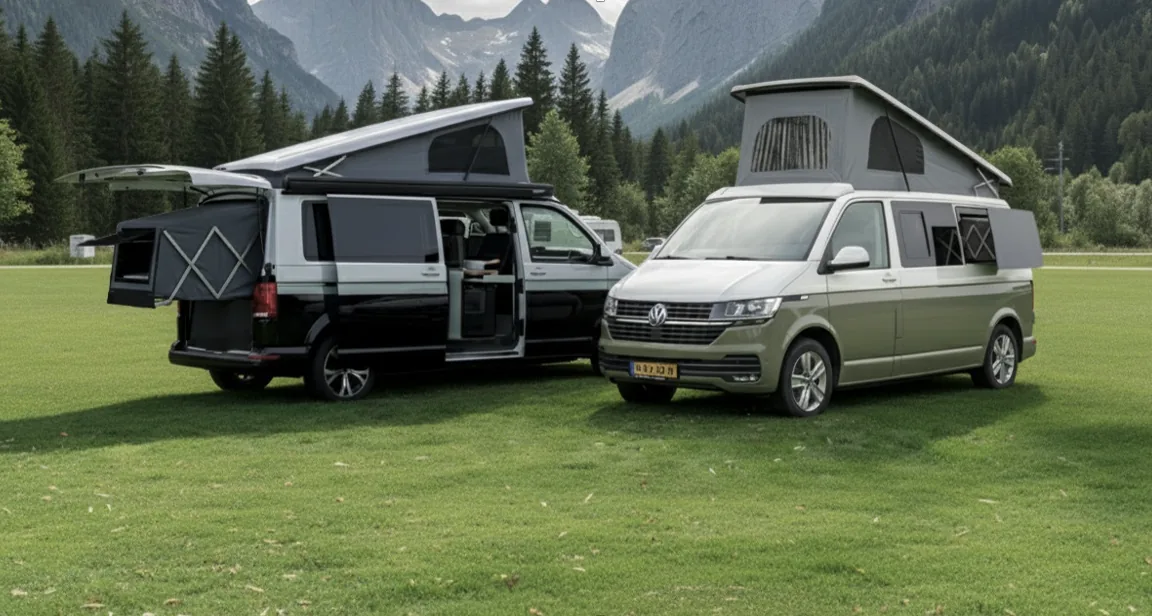
Compact is a stretchy term in the camper world. One manufacturer still calls a six-metre van compact, another means a converted station wagon. Below we explain which dimensions really matter, what level of comfort you can expect within those dimensions, and why a compact van camper is the most usable choice for many people.
What exactly is a compact camper?
A compact camper is a camper based on a closed panel van usually a VW Transporter, Ford Transit Custom or a similar size. The exterior dimensions stay within what you'd expect from a large passenger car: around 5.30 m long, about 1.95 m wide, and under 2.1 metres tall with the pop-top folded down.
That height isn't a minor detail. Under 2.1 metres you can enter multi-storey car parks, use most car washes, and drive through residential areas, narrow French villages and onto ferries without a second thought. Above 2.60 m the size of a larger panel van camper all of that disappears.
It's important to distinguish this from a campervan that's only compact on paper. A van without standing height, without a fixed bed or without a real kitchen isn't compact it's simply less complete.
The dimensions that actually matter
When comparing compact campers, buyers often focus on total length. In practice, three other dimensions have a much bigger impact on your travel comfort:
- Bed length: under 1.90 m, an average-height adult won't sleep comfortably. The Wally-Van has a bed of over 2 metres.
- Standing height: can you stand upright to get dressed and cook? With a pop-top, yes; without one, no.
- Storage in litres, not cupboards: a garage that fits crates, a tent, wet gear and bikes determines whether you can really go away for weeks.
Why compact works so well for everyday use
The biggest advantage of compact is that the camper doesn't sit idle. A larger panel van camper or coachbuilt camper sits in storage eleven months a year and costs money. A compact camper fits on your own driveway, in a parking space, and if needed in the multi-storey car park at work.
That means you'll also use it for a day at the beach, a trip to the DIY store, a festival, or a stay at friends. That changes the maths: you're not paying for three weeks of holiday, but for a vehicle that's part of your life all year round.
So where's the trade-off?
Let's be honest: a compact camper doesn't have a fixed bathroom with a shower and toilet. What it can have is a fixed spot for a portable toilet and an outdoor shower. For most travellers who stay at campsites, near harbours or at camper stopovers anyway that's exactly enough.
The second trade-off is that a compact camper needs a well thought-out interior. There's no room to waste. That's exactly what the Wally-Van concept is designed around: everything stays available at the same time bed, seating area and kitchen without you having to convert anything.
Read next
Want to see and feel it yourself?
Open day every month in Vinkeveen both models are ready for you.